engaged in camera related products' R&D, design and production



The ubiquitous usb 2.0 camera module has become an essential component in a vast array of modern technologies, from security systems and industrial inspection to consumer electronics and even medical devices. Its ability to capture and transmit visual data efficiently and reliably has driven innovation across countless sectors. Understanding the capabilities, applications, and future trends of these modules is crucial for engineers, product developers, and anyone involved in imaging technology.
The demand for high-quality, compact, and cost-effective camera solutions is constantly increasing, fuelled by the rise of IoT (Internet of Things), artificial intelligence, and machine vision. This escalating need places significant importance on advancements in usb 2.0 camera module technology, focusing on improved image sensors, processing power, and integration capabilities. Addressing challenges related to power consumption, latency, and environmental resilience is key to unlocking the full potential of these modules.
Effectively deploying and utilizing a usb 2.0 camera module requires a comprehensive understanding of its underlying principles, as well as its practical limitations and best practices for integration into diverse systems. This knowledge empowers developers to create innovative and impactful solutions across a broad spectrum of applications.
The global market for machine vision systems, a key area where the usb 2.0 camera module plays a crucial role, is experiencing substantial growth. According to recent reports, the market size was valued at USD 11.9 billion in 2022 and is projected to reach USD 19.3 billion by 2028, growing at a CAGR of 8.7% (Source: MarketsandMarkets). This growth is driven by the increasing automation in various industries, including manufacturing, healthcare, and logistics.
This demand extends beyond industrial applications. The proliferation of surveillance systems, coupled with advancements in AI-powered video analytics, is creating a significant need for affordable and reliable camera modules. The United Nations estimates that the global surveillance technology market is rapidly expanding, raising both opportunities and ethical concerns around privacy and data security. usb 2.0 camera module serves as a foundational element for many of these technologies.
A critical challenge within this expanding landscape is the need for robust, high-performance camera modules capable of operating in diverse and demanding environments. These environments include extremes of temperature, vibration, and humidity, requiring specialized designs and rigorous testing to ensure reliability and longevity. The usb 2.0 camera module must adapt to these pressures to remain competitive.
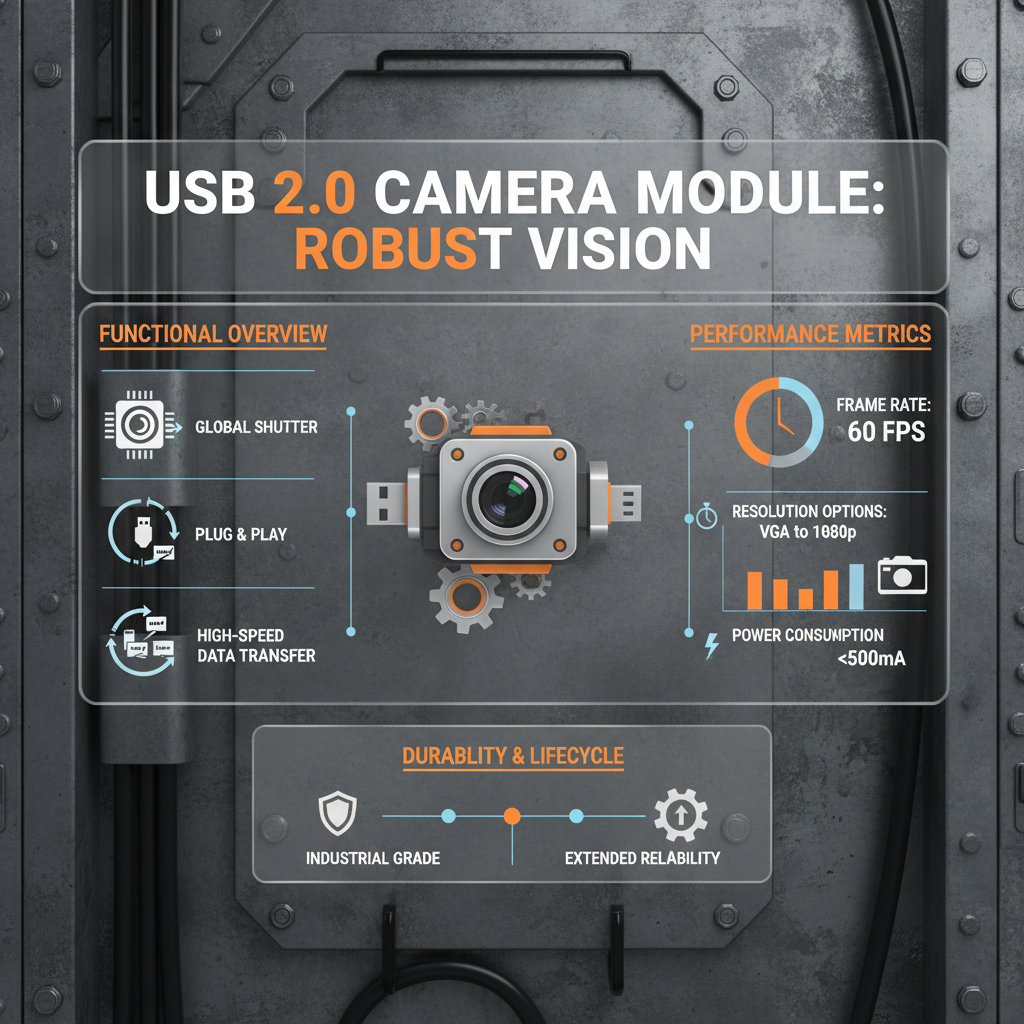
While USB 2.0 has bandwidth limitations, many modules can achieve resolutions up to 1280x720 or even 1920x1080 at reduced frame rates. Higher resolutions require efficient compression techniques to stay within the USB 2.0 bandwidth constraints. The actual achievable resolution depends on factors like sensor size, ISP capabilities, and data compression algorithms used within the usb 2.0 camera module.
Reducing latency involves minimizing data transfer overhead. Utilize optimized drivers, efficient compression methods, and consider using smaller image sizes or regions of interest (ROI). Direct Memory Access (DMA) transfers can also help reduce CPU load and improve responsiveness. Properly configuring the USB host controller and minimizing USB cable length are also crucial for achieving lower latency with a usb 2.0 camera module.
Low-light performance is primarily determined by the image sensor’s sensitivity, pixel size, and the ISP’s noise reduction capabilities. Sensors with larger pixels generally capture more light. Back-Side Illuminated (BSI) sensors offer improved light sensitivity. Effective noise reduction algorithms implemented in the ISP are essential for producing clear images in low-light conditions. A high-quality usb 2.0 camera module will prioritize these features.
Yes, it is possible, but the number of modules that can be connected depends on the computer’s USB bandwidth and the power available from the USB ports. Using a powered USB hub is often necessary to provide sufficient power to all modules. Be mindful of the total bandwidth consumption to avoid performance degradation. Proper driver installation and configuration are also critical for ensuring compatibility and stable operation of multiple usb 2.0 camera modules.
usb 2.0 camera modules are widely used in robotics for visual navigation, object recognition, and robotic manipulation. They enable robots to perceive their environment and perform tasks autonomously. Common applications include bin picking, assembly line inspection, and autonomous mobile robots (AMRs). Their affordability and ease of integration make them suitable for both research and industrial robotics applications.
The typical lifespan of a usb 2.0 camera module is 5-10 years, depending on operating conditions and usage. To extend its lifespan, protect it from extreme temperatures, humidity, and physical damage. Avoid excessive vibration and ensure proper power supply. Regular cleaning of the lens and proper cable management can also contribute to a longer operational life.
In conclusion, the usb 2.0 camera module remains a versatile and cost-effective imaging solution with widespread applications across numerous industries. Its simplicity, compatibility, and affordability continue to drive its adoption in areas ranging from industrial automation and security surveillance to medical imaging and robotics. Understanding the core components, limitations, and emerging trends associated with these modules is crucial for leveraging their full potential.
Looking ahead, advancements in image sensor technology, ISP algorithms, and edge computing capabilities will further enhance the performance and functionality of usb 2.0 camera modules. By embracing innovation and addressing existing challenges, developers can unlock new possibilities and create impactful solutions that address real-world needs. Visit our website at www.szmyccm.com to explore our range of high-quality camera modules.